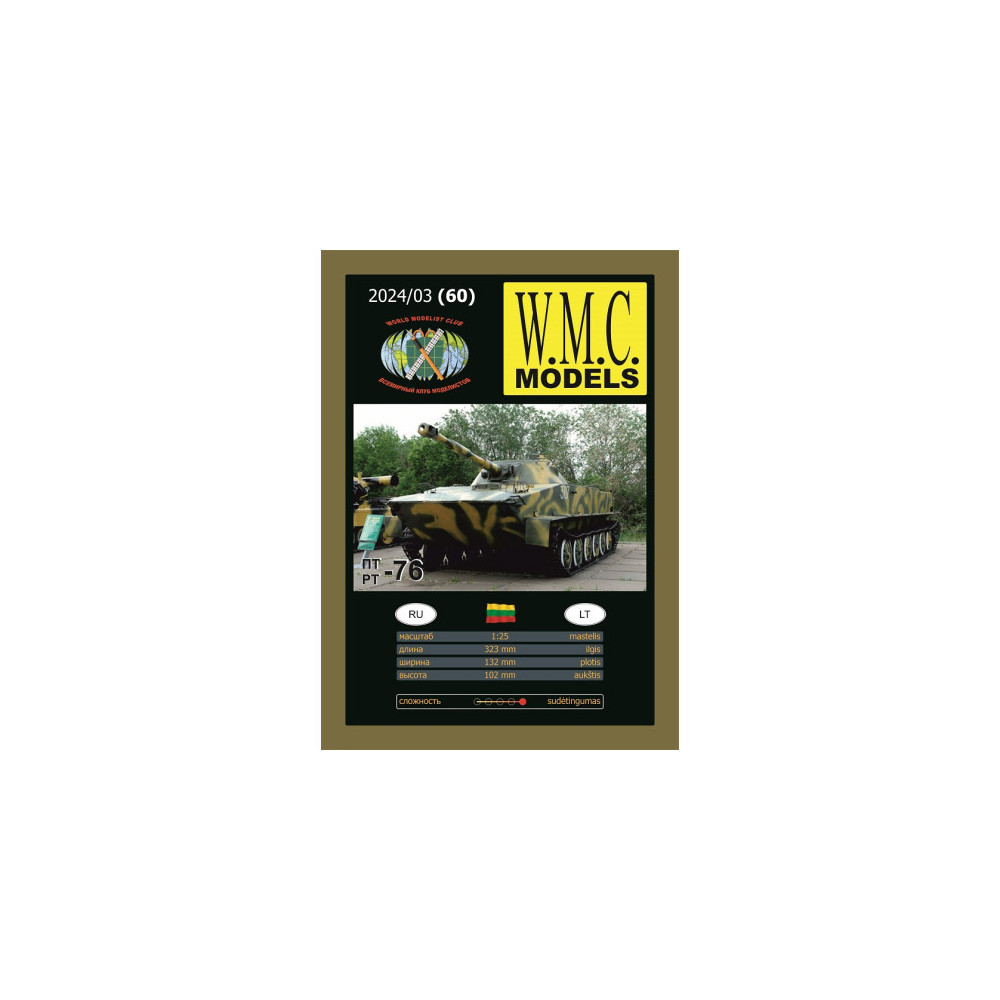
PT-76 is a Soviet light amphibious tank of the postwar period, developed by engineers at the Chelyabinsk Tractor Plant design bureau in 1949–1950. The creation of a combat amphibious vehicle was especially important for the USSR due to the threat of war with Western countries: in the event of military operations, the Soviet Army would have needed to cross a significant number of rivers and swamps in Europe, which would have posed great difficulties. "Object 740," having demonstrated excellent performance during tests in 1950, was adopted into service under the designation "PT-76." The combat vehicle was repeatedly modernized: for example, from 1959 to 1967, the PT-76B was produced, distinguished by the installation of a modernized 76-mm D-56TS gun with a two-plane stabilizer. In total, from 1951 to 1967, 3,039 units of various PT-76 modifications were built, including about 1,200 PT-76B units. Still in service with many armies around the world to this day, these tanks have seen combat in numerous armed conflicts, including the Vietnam, Six-Day, Chechen, Yugoslav, and Iraq wars.
A small, well-designed, and finely detailed model of a Russian light amphibious tank from the Chechen War era, this is a complex model in a colorful spotted camouflage. The model features a well-detailed fighting compartment in both the hull and turret sections, a driver’s station, running gear, and exterior details. There is no detailing of the engine compartment. The tracks are provided in two versions—continuous bands and individual links. Where necessary, parts are printed with double-sided printing, there are quite noticeable signs of wear, and a fairly substantial range of colors is included. The model is intended only for intermediate and advanced modelers.


 Русский
 Latvija
 English