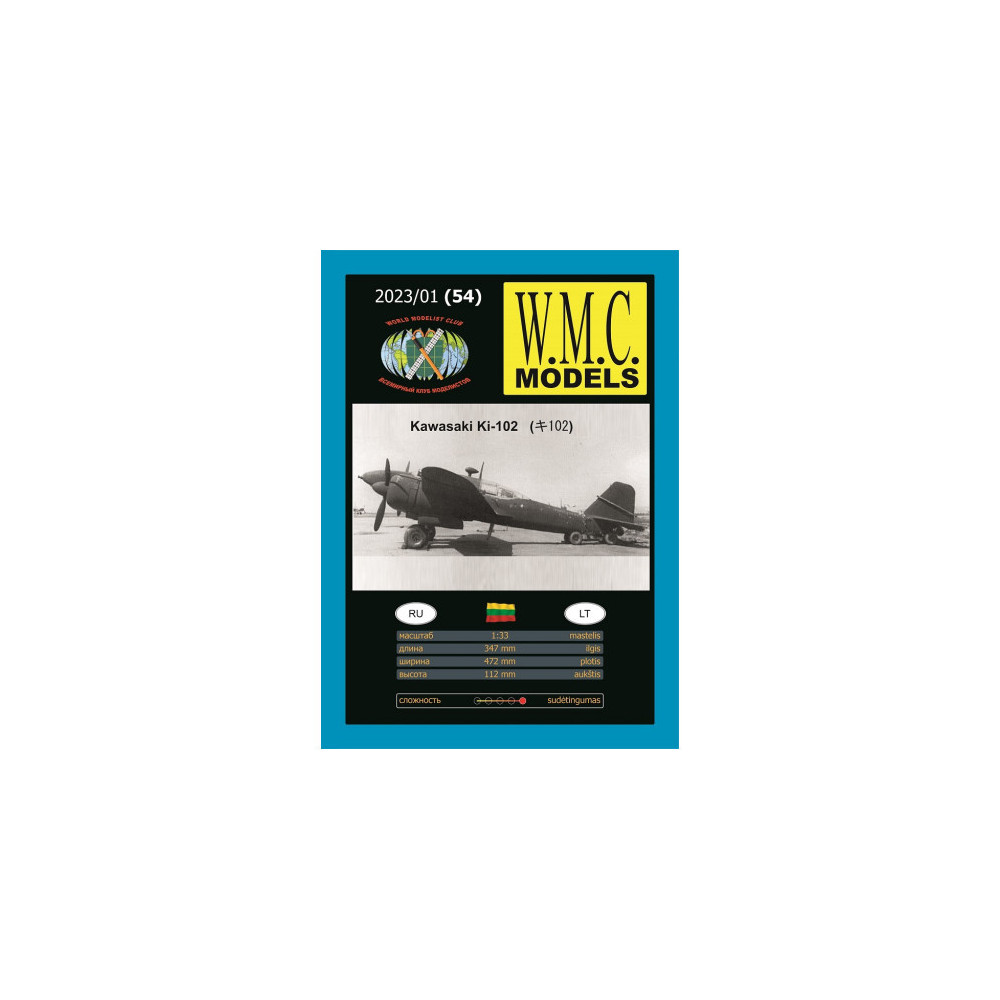
Kawasaki Ki-102 (Army Assault Aircraft Type 4) was a Japanese combat aircraft from World War II. It was a twin-engine, two-seat, long-range heavy fighter developed to replace the Ki-45 "Toryu." Three variants were planned: the Ki-102a—day fighter, Ki-102b—attack aircraft, and Ki-102c—night fighter. Among the Allies, this aircraft was called "Randy." The Ki-102 entered service in 1944 but was hardly used. The main type (102b) was kept in reserve for the defense of Japan, although it saw some limited use in the Okinawa campaign. It was not used on the front lines because it was hoped that it would become a carrier of the "Igo-1-B" air-to-ground guided missile when the Allied invasion of the Japanese islands occurred.
The model is meticulously designed and highly detailed, so it is suitable only for intermediate and experienced modelers. The engine mock-ups, landing gear and its bays, and cockpit interiors are excellently detailed; there is a reserve of colors where necessary, some parts are printed double-sided, and signs of use on a lightly used aircraft are visible only on light surfaces.