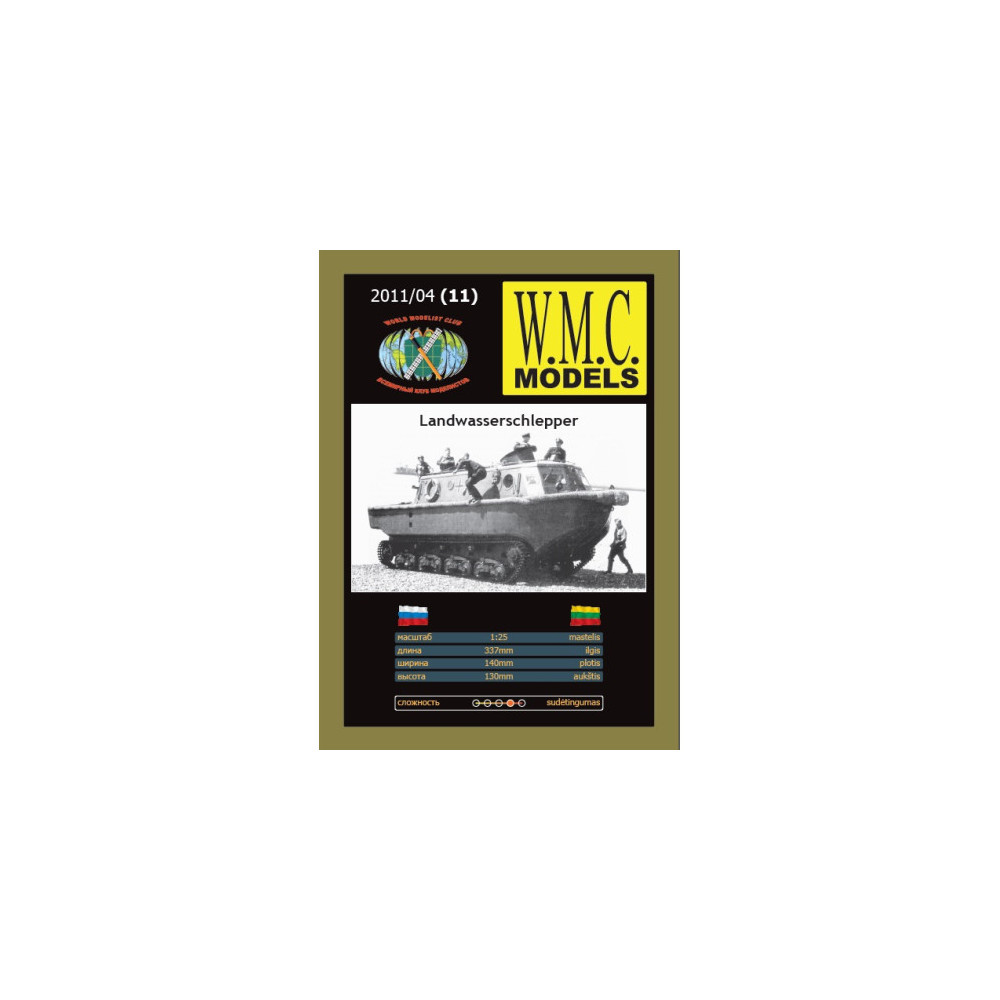
In May 1935, the Engineering Department of the German Ministry of Armaments prepared technical requirements for the production of an amphibious vehicle for transporting or towing a trailer with military cargo. The contract for the design and production of the Landwasserschlepper was awarded to Rheinmetall-Borsing AG from Düsseldorf. The design and development progressed very slowly, and only after the French campaign, when the question of an invasion of the British Isles arose, did things accelerate. Thirty vehicles were ordered, but only 23 were produced by 1945. However, they were rarely used because the running gear often broke down and they were not armored. This is a complex but easy-to-assemble model, with the greatest difficulty—as with all tracked vehicle models—being the running gear and tracks. And, as everyone knows, the Germans tended to make the running gear as complicated as possible, so you can imagine what a treat awaits. But in the case of this model, assembling the running gear leaves only pleasant impressions: the assembly sequence is thought out down to the smallest detail, there is no textual instruction in the edition, but it is not needed—everything is explained in the diagrams