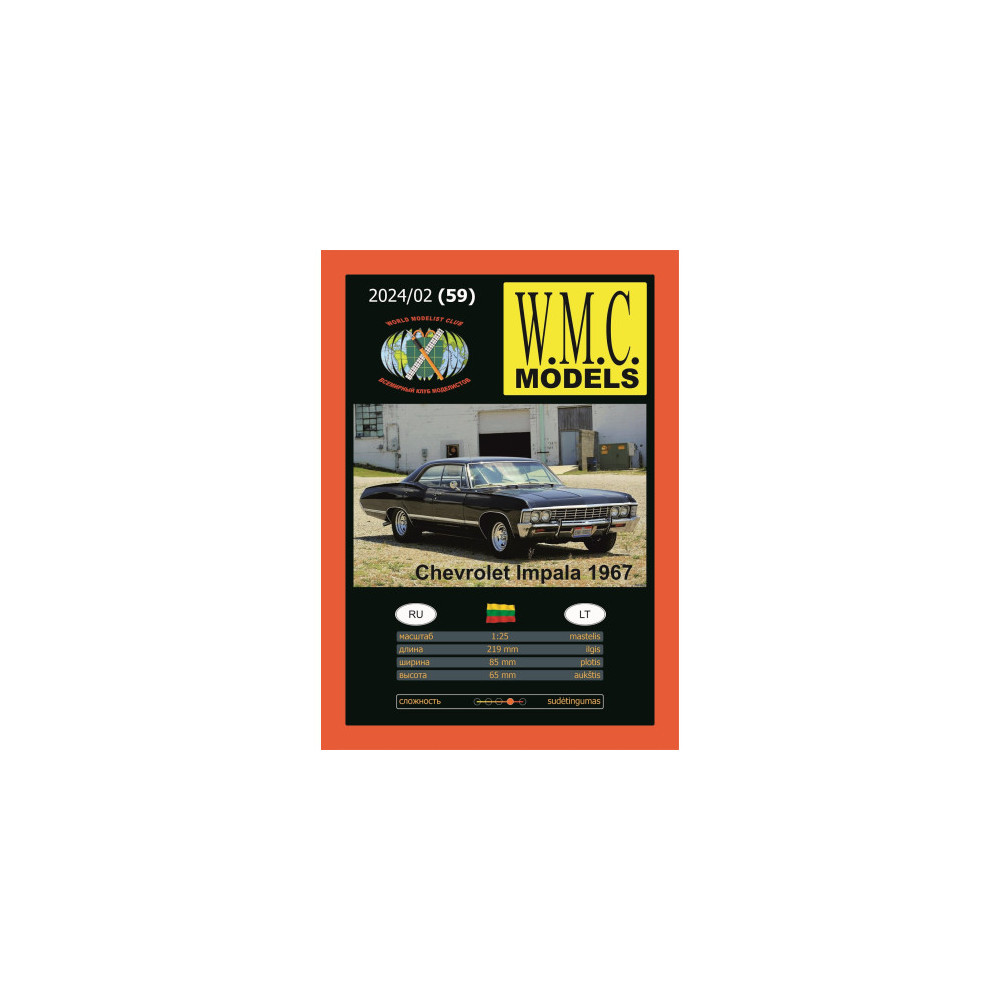
Chevrolet "Impala" is an American full-size car produced by the GM division "Chevrolet" as a model from 1958 to 1985, from 1994 to 1996, and from 1999 to 2020. The car's position in the model lineup varied depending on the year of production. Until 1965, it was the most expensive Chevrolet passenger car. In addition, a sporty modification, the "Impala" SS ("Super Sport"), was produced. From 1964 to 1967, it was positioned as a separate model, and in other years, it was offered as a trim level. There are a total of 10 generations of this model. The 1965–70 generation belonged to the 4th generation. Unlike the strict, even somewhat austere "Impala" of 1962–1964, the next generation had a distinctly aggressive design with a "coke bottle" side line (with a kink above the rear wheel arch), typical for the second half of the sixties. The side windows were made with a curved upper edge, and on hardtops, they had no frames (previously, the frames were removed along with the windows). The model range once again included a convertible, coupe, two- and four-door hardtops, four-door sedan, and station wagon. The choice of engines and transmissions was significantly expanded. The "Super Sport" modification featured an interior with separate seats and a center console, as well as a wide, shiny molding with a black insert that extended under the taillights. By American standards of the time, the successful body design of the 1965 model remained "in service" for a long time. In 1967, it underwent a restyling, receiving more refined sculptural detailing—the body sides became slightly smoother, headlights recessed into the grille appeared, and large turn signals were added on either side of the headlights, making the car look more harmonious and aggressive. From that year, the taillights were no longer round; instead, wide, horizontal, three-section lights with pointed edges appeared. A black 1967 model hardtop sedan was used by the protagonists of the TV series "Supernatural." In 1967–1968, new legislation forced automakers to seriously address safety, resulting in the "Impala" receiving a collapsible steering column, padded dashboard, turn signal repeaters, and three-point seat belts (only on closed body styles) during those years.In 1969, the last version of the "Impala" SS appeared, which differed from the previous one mainly by having disc front brakes as standard equipment, after which production of the car under this name was discontinued for a long time.


 Русский
 Latvija
 English